

Introducing Granite Points

In August, we shared what's next on Granite, including a points program built to reward the people who show up. Today it's official: Granite Points are live on USDCx.
Since October, every wallet supplying liquidity, borrowing, or posting collateral in the USDCx market has been earning points, and those points are already banked. Points reward two things: how much you put to work, and how long you keep it there. Stay in, and your earning rate climbs to as much as 10x.
Here is how it works.
What Points Measure
Granite Points measure a wallet's participation in the USDCx market over time. Every position counts: supplying liquidity, borrowing, and posting collateral.
Your points are banked, and they never go down. Points accumulate as a running total. Withdraw, close a loan, or step away entirely, and everything you've already earned stays yours.
What resets is your tenure, not your balance. If you fully exit and come back later, your earned points are untouched, but your new position starts again at the base multiplier. Staying in is how your rate keeps climbing.
How Points Are Calculated
Points are scored in snapshot rounds, roughly every 2 to 3 hours (~720 Stacks blocks), since block times vary day to date. Each round, a wallet banks points for every position it held:
Points = value × tenure multiplier × time held
- Value is the position's USD value at the snapshot price.
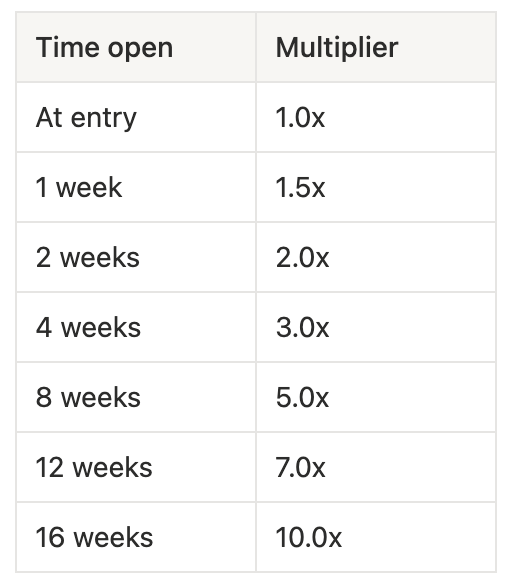
- Tenure multiplier rises the longer the position has been open (see below).
- Time held is how long the position was actually open during that round. Enter or exit mid-round and you earn for exactly the time you were in.
Why time held matters. Snapshot timing is predictable. If points were based on a single sample at each snapshot, a wallet could deposit seconds before every snapshot and collect a full round's worth of points. Scoring the full time held closes that loophole, and it means there's no penalty for entering or exiting at the "wrong" moment. You earn for what you actually contribute.
Partial withdrawals protect your tenure. Each deposit is tracked separately. When you withdraw part of a position, your most recent deposits are withdrawn first, so your oldest deposits keep their original start dates and their higher multipliers. A full exit ends that position's scoring, and a new position starts fresh at 1.0x.
A $10 minimum. Points accrue while your wallet's combined position value across USDCx is at least $10. The minimum applies to your total, not to each deposit, and it never reduces points you've already banked.
Multipliers: Rewarding Time and Liquidity
Tenure multiplier. The longer a position stays open, the faster it earns. A position held for 16 weeks earns 10x what it did on day one.
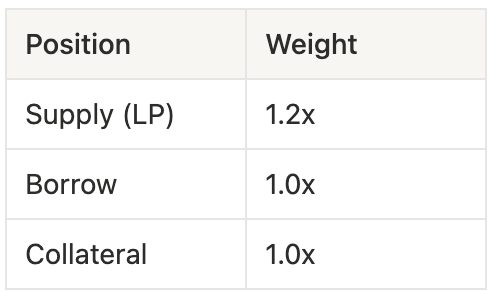
Position weights. Supplying liquidity is what makes the market work, so it earns a boost.
Referrals
Bring people to Granite and you earn alongside them. Each round, you earn 10% of the points your referrals earn, including what they earn from their own referrals, so the bonus cascades up the chain. In practice, that's 10% from people you refer directly, 1% from the people they bring in, and so on.
Referral points bank the same way as everything else, so they never go down. They're paid even if you don't have an active position yourself, and the $10 minimum doesn't apply to them.
Check Your Points
You can see where you stand on the Granite Points leaderboard at https://app.granite.world and points have been accruing since January 2026.
A note for aeUSDC users: points currently apply to the USDCx market only. The aeUSDC leaderboard is empty by design.
Showing Up Pays Off
Granite Points are built around a simple idea: the people who commit to Bitcoin DeFi should be the ones who are rewarded for it. Every round you stay in, your points grow, and your rate grows with them.
If you're already active on USDCx, you're already earning. If you're not yet, the best time to start your clock is now. Launch the app to get started, and follow @granitebtc for updates.
Last Edited
November 12, 2026
Related
What's Next on Granite: STX Markets, a Points Program, and DeFi Incentives
The next phase of Granite is here. More assets, more ways to earn, and a deeper role in the Bitcoin DeFi ecosystem are all on the roadmap. Here is what is coming and why it matters.
August 14, 2026

Granite is Now Listed on Borrow On Bitcoin
Granite is now tracked on BorrowOnBitcoin, the leading independent comparison site for Bitcoin-backed loans. Bitcoin holders researching how to borrow against their Bitcoin can now find Granite's market data, rate history, and risk parameters alongside every other major onchain and CeFi Bitcoin lender, all on one site.
September 3, 2026